
Homeland Tea
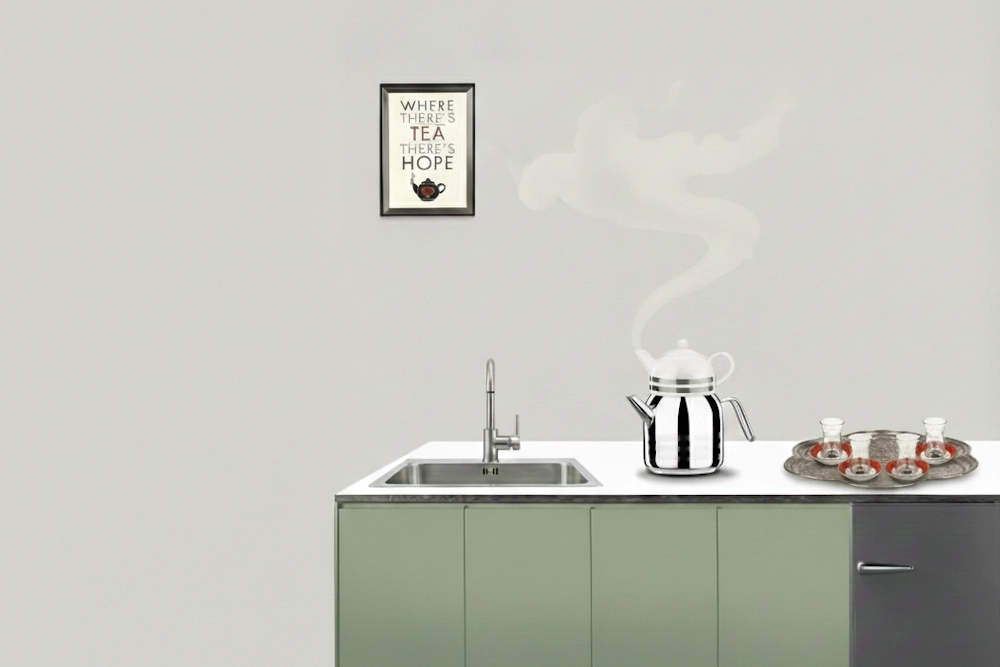
I hang the wooden frame containing my grandmother’s lasting message on the wall above the kitchen counter. The air is thick with steam. Shajarian’s mournful voice merges with the kettle’s bubbling seethe. Now and then, a jet of steam shoots up from the kettle, and the china teapot above it trembles. Like genie smoke, a white puff carries the scent of tea throughout the forty-square-metre apartment. The timer on the counter, which my wife had set to twenty minutes, hits three.
Meenu, wearing large glasses and a navy blouse and skirt, sits by the apartment’s lone window, typing at her computer. “I’m aching for Taraneh,” she says. “She didn’t call. Hasn’t she made it home yet? My eyes keep darting to that Skype corner. I keep thinking I see it flicker.”
I step off the cold ceramic floor onto the sun-yellow jajim rug and reach the bookshelf in three strides.
“My love, what do you want me to do? She didn’t want to come with us. I, too, can’t go back to that ruined place. They’ve opened a case for all the articles I’ve written over the past ten years, going back to ‘97. I’d rather die right here. May even my corpse never reach them.”
“That’s enough. You don’t have to say it over and over, darling. Anyway, our daughter had every right. She couldn’t tear herself away from the city and the people she grew up with. Even when we lost our home, she didn’t say a dickybird—just left for Hamid’s mother’s. You need to stop working yourself up. All this worry’s no good for your heart.”
I turn Shajarian’s music down. Meenu worries about my heart. I’m chasing something else—deliverance from this disgrace. She can’t even sleep at night without pills. I’d better start telling her bit by bit so the news from Iran doesn’t catch her off guard.
I pull The Adventures of Hajji Baba of Ispahan from the shelf. I’d been reading it last night and dozed off at the end of chapter twenty-eight. I sink into the oversized couch behind Meenu’s seat. By day, it’s our tea-drinking divan, by night, Kamran’s bed. Meenu and I sleep on the metal fold-out bed beside it.
A faint whine comes from the kitchen.
I point to the under-cabinet refrigerator. “Darling, Kamran promised to bring someone to fix the buzzing motor in this tiny fridge. Looks like I’ll have to deal with it myself.”
She glances away from the monitor toward the kitchen. “You’re right. At night, that low hum keeps us from sleeping. During the day, it scrambles my focus.”
In the heat of the Iranian presidential election, angry youth, protesting the engineered results, poured into the streets in opposition to ballot tampering. Chaos and insecurity escalated. The government failed to control the crowds. Incompetent officials organized imprisoned thugs and street hooligans, sending them against the people alongside the police.
Far from Iran’s turmoil, in the peaceful corner of this modest refuge in England, I worry about the scions of my homeland. I stroke Meenu’s braided hair. “My darling, put that aside. Come talk with me a little before that boy shows up. My heart is heavy.”
She says, “Alright. Wait until the tea steeps. I need to finish this article quickly so they’ll deposit some meagre money into our account. With fresh-brewed tea, I’ll come and sit close to your heart.”
“The way you make tea reminds me of my grandmother. Rest her soul. She had a golden-colour coal samovar, made in Borujerd. She called it ‘the brass bath.’ She’d take an hourglass from the drawer and flip it over. She’d pour tea leaves and boiling water into the china teapot and set it on the samovar’s crown. She paid close attention to the steeping time, just like you. Remember the day my mother and I came to propose to you? When you served me tea, my mother whispered in my ear, ‘This girl has touched my heart. She’s natural and pleasing, like the well-steeped tea she brought.’”
Meenu stares at the screen, pulls her hair back with both hands, and blows out a sharp breath. She seems agitated. “No one expected the revolution would turn life this chaotic. That lowlife regime pushed people into whining about stupid things and made them forget beautiful traditions. Remember the samovar my mom gave me in my dowry? We’d tossed it in the storage room, gathering dust.”
I nod in agreement. “The same storage they seized with the house. So that’s their gratitude for all the years of suffering I endured.”
“The house, the car, everything we owned—gone, all for a strand of your hair. Of course, those days were brutal. All the people we knew vanished in a blink. We were left alone, with no one . . . Let it go, love.”
I open my book at the marker. It’s the scene at the doctor’s house where the court poet reads a poem in praise of the Shah.
At the qasida’s recitation, all stood in rapt silence. The king exclaimed, “Aferin! This is well; you are indeed a poet and worthy of our reign. Who was Ferdousi compared to you? As for Mahmoud, the Ghaznevi, hâk bûd, he was dirt.” Turning to the noble of nobles, he said, “Go, kiss him on the mouth, and when that is done, fill it with sugar-candy.”
The noble of nobles, endowed with a large and bushy beard, approached the poet and inflicted a kiss upon his mouth, which became entangled in the hair. Then, from a plate of sugar-candy, he took a handful, crammed it into the poet’s mouth, and inserted it with his fingers as was customary.
The poet, though evidently distressed, strove to appear at the height of happiness. He forced a strained grin, contorting his face so that involuntary tears flowed from his eyes as fast as the sugar-candy melted through his lips.
The king then dismissed his courtiers and attendants, and the royal feast began…
Someone taps on the window. A key turns in the lock.
I smirk at Meenu. “You see, sweetheart? The boy came, but you didn’t, and I never got to open my heart to you. Sometimes I feel like I’m about to burst.”
Kamran walks in, wearing a carmine raincoat and blue jeans. “Well, looks like you two found yourselves a cozy little corner, huh?” He steps in further, unzipping his boots.
Meenu says, “Hello, my son. This’ll do. In this matchbox of a place, there’s no space to keep our distance like back in Iran. And friends or neighbours don’t drop by all the time anymore.” She gives Kamran a once-over. “Leave those muddy boots by the door.”
I say, “Son, it seems kids don’t even trouble themselves to say hello anymore.
Kamran shrugs off his coat and hangs it on the wall hook near Meenu. “Lighten up. Grandpa always said, ‘Say hi to your elders. Be respectful.’ In the end, he just said hi to God—and that was it. Gone.”
Meenu turns to me and whispers, “I told you, things are different here. At school, I see teachers greet the students.”
Frustrated, I toss the book onto the table. “The sheikhs know nothing of Iranian culture. On TV and in schools, they gabble in Arabic and chant lamentations. Unaware of ancestral manners, our young follow foreign examples.”
Meenu, her brows knitted, pushes Kamran’s coat aside, beside the computer. “Sweetheart, your coat’s dripping. Hang it in the bathroom.”
Kamran gives a faint smile, locks eyes with his mother, and rests a hand on his stomach.
Meenu taps the back of her hand. “You know what time it is? We ate without you. It’s ten. I left your food in the fridge.”
Kamran’s eyes spark. He clenches his teeth and raises both fists with a smile. “Good news! I got the dorm. Got the key.”
Meenu, frowning, shoots him a glance from the corner of her eye. “How many in one room?”
Kamran places a plate of rice and stew from the fridge into the microwave. “Two roommates. One’s a Pakistani student. The other’s British, from Scotland. The place is tight, about a third the size of this.”
“Smaller than this suite? Why not just stay here with us, son?”
“Mom, think about it. What if the government takes this place back? What happens to my studies then? I’d be stuck mid-term.”
The timer rings.
Meenu looks at me as she rises from the desk and walks over to the tea. “Sweetheart, that’s enough for today. The computer’s all yours.”
I say, “I’ve talked your ear off and kept you from getting anything done. You’ve been sweet, not to mention how chatty I’ve been lately. I just can’t help it… So I’ll get on the computer and pick up the story.”
She looks at me. “Your patience never runs out! I edited your drafts from yesterday and filed them under short stories. Just don’t shut Skype. I’m waiting for Taraneh’s call.”
Kamran fans his hands side to side. “God gave us a nutty sister, all right.”
I frown at him, slide the book back onto the shelf, and walk to the computer. As I settle into work, I hear the clinking of tea glasses in their saucers. The aroma of Lahijan tea drifts to me. I smile at Meenu.
She sets the old Warsaw tray on the coffee table and wipes the splashed tea from the saucers. Ruby tea glows in four slim-waisted glasses, and shadowy phantoms rise, dancing from them.
We smile at each other. My heart settles. “Sweetheart, bless your hands.”
Kamran shrugs. “If our sister had a shred of sense, she wouldn’t throw away her future and her family just to chase some boyfriend and an election.”
Meenu covers her mouth with her fist. “Son, Taraneh and Hamid are engaged—what do you mean, ‘boyfriend’? And besides, your sister didn’t want to become a refugee. Respect her choice.”
Kamran wrinkles his nose and nods at the tea tray. “Oh, come on—what’s with this grassy tea Auntie sent? Brew some Cuban coffee, get a real buzz. I’m stacking my Costa Coffee shifts to buy you a Keurig.”
Still typing, I say, “Out here in exile, nothing compares to tea from home, especially when Meenu brews it.”
Meenu fills the kettle under the kitchen tap. “Son, save that nine-pounds-an-hour for your university fees. We don’t want that kind of stuff.
Kamran huffs. “Savings?” He shakes his head from side to side. “Everything I saved in Iran went up in smoke with inflation and the exchange rate. Might as well spend what I’ve got—or buy something for you. Didn’t the sheikhs say paradise lies beneath parents’ feet?”
Meenu sets a pot on the stove. “We’ve got those machines at school. Teachers pull Keurig pods from their bags, pop them in—zip, zip—and thirty seconds later, their cups are full.” She glances at the teapot and opens her arms toward the tea-filled glasses. “I let my tea steep for twenty minutes. That’s how it turns into this.”
“But, Mom, time is gold. We can’t waste it on brewing tea. These Keurigs hit better.”
“Don’t compare real Lahijan tea to that synthetic stuff. I can smell they’re fake. Didn’t you say the Brits lift their wine to the light, sniff it, and hold it in their mouth before swallowing? Do the same with tea, enjoy it. Let a drop of this touch your tongue, see what your taste buds say.”
“Forget it, Mom. Here too, the old-school folks go for organic stuff.”
Meenu smiles at me, then turns to Kamran. “When I wash the teachers’ lounge cups, the coffee stains barely come off with a rough scrubber. Your father washes our glasses by hand. They come out clean and clear. Look at the teapot. Spotless.”
I nod. “Right. Market tea’s packed with three chemicals to alter the taste, colour, and scent. Iranian tea doesn’t have this stuff. Our factories are old-fashioned.”
The computer rings. My heart rate rises. Kamran turns toward us from in front of the wall mirror.
Taraneh’s photo appears in the centre of the screen, with a green scarf over her head.
Meenu, her face flushed, rushes toward me in short steps. “My Taraneh.”
Kamran smirks. “Chill, Mom.”
I tap the green button.
Hamid’s face appears, hair tousled. “Hi, Father.”
“Hi. How are you, son?”
Kamran steps closer. “That’s patriarchy for you. The girl’s Skype is in her fiancé’s hands.”
Meenu slaps her hand. “Oh God, kill me. Where’s Taraneh?”
Hamid fumbles. “It’s nothing serious, Mom. I got home a bit early, and, well . . . the internet was working, so I thought I’d give you a call. Most places, the phones and networks are down.”
Meenu leans in and frowns at the screen. “Sweetheart, where’s your wife? Tell me the truth.”
Like a guilty child flustered by his mother’s question, Hamid stammers, “That’s it, Mom.” I took a taxi from the university to pick her up, but the headquarters was swarming with agents—so packed, I couldn’t get in.”
Meenu narrows her eyes. “Then why’d you come home alone?”
Hamid trips over his words. “It’s just . . . my phone wasn’t working, so I couldn’t call her.”
The simple boy can’t even lie right.
Kamran grins. “C’mon, spill. You got carried away, played reporter, and they grabbed your phone, huh?”
Meenu nudges Kamran aside. “Let me handle this. Hamid Jan, did you try calling her from another phone?”
“I did, but her phone was off. The taxi driver was freaking out, kept pushing me to leave. So, I came home, hoping she’d be here. Now that she’s not, I’m heading to my dad’s to grab the car and look for her. You get some sleep. I’ll call you in the morning your time.”
Meenu’s voice quivers. “Feels like you’re hiding something. It’s just past ten here, but late over there.”
“Yes, Mom. Way past midnight. But people are still out, worried about the election.”
Kamran lets out a sharp breath. “Wishful thinkers.”
I ask, “You still haven’t bought a car? You said you’re teaching at the university.”
Hamid says, “Ah, Father! Even if I work for years, these wages won’t even get me a junker. Don’t compare it to your days.”
I sigh. Why should Iran’s youth be cut off from their own country’s wealth? The sheikhs think they’re God’s agents. They bury people in a thousand miseries, grab the nation’s assets, then call it a gift from God.
Hamid raises his eyebrows. “You taught in the education ministry, had your doctorate, started as an assistant professor right off the bat. I know you didn’t rise to associate and full professor ranks lightly, but these days, whether you’re a rookie instructor or a veteran professor, you get the same treatment: low and lousy. The faculty deputy paid a fortune for a Peugeot, and they told him it wouldn’t be ready for two years.”
I run both hands through the thinning hair on top of my head. “You know how they treated me after all that? I was left to rot in solitary. Foolish of me to trust a pack of deceivers. That’s what truth and integrity come to when the corrupt hold power. I wish the book of my life had closed back when we were still young and full of light.”
Meenu turns her face to me, lips pressed tight in a frown.
I give a bitter laugh and rise, letting her take my seat.
Since yesterday, I’ve been secretly in touch with Hamid. We’re both waiting for news of Taraneh. I still have to keep it from Meenu. Oh God, whose body did they find? I lift my tea glass and, through that ruby cup, steal a look at Meenu.
Shajarian sings softly:
Flame-throwing in the cage, O fiery sigh. O hand of nature, do not pluck the flower of my life.
Tears well up in my eyes. I breathe in the scent of the tea. I put on another song. Kourosh Yaghmaei sings:
I’m a fisherman, lonely and tired, sitting by this harbour, in my boat. My boat of hope has run aground.
The song feels familiar. I lean back against the sofa cushion and close my eyes. My mind drifts to 1974, to Sheikhs’ Mountain in Lahijan, though the locals called it Devils’ Mountain.[1] On the slope of a hillside covered with dense tea gardens, I sit on a stone step beside a friend, watching a large pond. The autumn breeze is blowing. I hear this same song, “Sunset at the Harbour,” playing from my new car’s speakers. I parked my swift Rakhsh close by, a brand new sunny-yellow Javanan. The latest Paykan model, the Iranian version of the Hillman GLS, was priced at twenty-nine thousand tomans by the Iran National Company. I had to save a teacher’s salary for a year to buy it, but I wasn’t going to drag my feet to have it. I took on extra work this summer and went to a boarding school near Zahedan. I taught and counselled sixteen hours a day, from dawn to dusk. When I got my salary, I went straight to the company showroom and pulled this mini-steering stallion out from behind the window display that very day. Bank Pars gave me a four-percent loan for travel expenses. New car, cash money, compensatory leave, and cheap gas at six rials a litre; everything came together for touring Iran, from coast to coast. I’m here to travel from the Caspian coast through the northern cities, driving town to town southward until I reach the Persian Gulf in ten days.
Yaghmaei still sings:
My heart can no longer bear this distance from you…
May it be remembered fondly – I was sitting in the middle of tea paradise, and now I’m waiting for a package of that tea to arrive in the mail.
Meenu’s sobbing pulls me back. She’s staring at the screen, whispering,
“Oh God, just let this mother die already. The head of Iran’s parliament said . . .”
She pauses, hiccups.
“Said, ‘ER nurses reported that officers brought in a girl named Taraneh with a torn vagina, then rushed her away. Later, her burned body was found outside the city.’ Oh no, no. It can’t be my Taraneh, never! If she’s gone, what’s left for me now?”
Kamran leans forward on the couch, mouth open, staring at his mother.
I pick up my cold tea glass to put it in the sink. My foot catches on Kamran’s muddy boots, lying in the middle of my path. I sway unsteadily. I hold the glass, but the saucer slips and shatters on the floor. Shards of china scatter everywhere.
I look at Meenu through tear-filled eyes. She’s staring back at me over the white handkerchief pressed to her nose.
I pick up the larger, sharp pieces and wrap them in newspaper. I open the cupboard under the sink and sit down. My eyes lock on a strip of black tape in the upper corner. I hid it there last week.
I peel off the tape and look at the cyanide capsule stuck to it.
No, no, that’s selfish. Meenu’s still here. Having tea with her is life itself.
I crush the pill and the tape into the crumpled newspaper beside the broken saucer and toss them all in the trash.
I straighten up. The wooden frame on the wall is damp. Water droplets race down the glass in parallel lines. Above the drawing of a teapot and a heart, the words say, “Where there’s tea, there’s hope.”
[1] Sheikhan-Kuh / Sheytan-Kuh