
Hero Is in the Mirror
In September 2022, as Iran approached the month of Mihr,[1] our lives were thrown into turmoil by two tempests. The local news was dominated by reports of a hurricane barreling toward our region in eastern Canada. The Canadian Hurricane Centre announced that a storm had formed from tropical cyclones off the coast of West Africa, intensified as it crossed Bermuda, and was now surging northward. It had already ravaged several islands along its path. Each day, each hour, warnings grew more urgent. People rushed to stores, stocking up on food, batteries, propane, and water containers.
At the same time, Farsi-language media carried grave news from my homeland, Iran, in the heart of the Middle East. The morality police had arrested a young Kurdish woman named Gina and, just hours later, left her unconscious at a hospital. She never woke up. Reports flooded in by the minute of swelling protests across the country. From every province, people poured into the streets. Troubled by the tempest in Iran, we kept our ears tuned to the local typhoon reports.
The World Meteorological Organization had named this hurricane “Fiona.” Government centers warned that its scale was unprecedented in recorded storm history. I had experienced windstorms and whirlwinds in my homeland, but I had never faced the devastating force of hurricanes and tornadoes. These storms form in the ocean, gradually increasing their scope, speed, and power. Their impact on tranquil coastal regions poses significant challenges. Two forces pulled at me: the yearning to witness, and the fear of loss. Within me, the thrill of seeing such a rare event was mingled with anxiety about potential damage to our new home. We had built that house with great effort and under significant constraints. Only a short time had passed since we had settled in that property.
We bought that old house with several acres of wooded land in a rural forested area some time ago. Several generations had lived in its dilapidated structure. Their last descendant used it as a seasonal cottage. He sold it to us before moving away. We planned to live there, but the layout and condition of the building weren’t suitable for year-round living. We set to work tearing off the wall coverings with the goal of renovation. With each layer we peeled away, more damage came to light. As the work progressed, we realized that older construction methods didn’t align with today’s standards, and the interior layout didn’t match our expectations. The framework was constructed from rare oak dating back to the previous century, while the roof and foundation had been recently updated. We expanded the project to a complete remodelling, keeping the warp and woof while rebuilding the spaces and surrounding elements anew. The shortage of skilled workers and the high cost of materials stretched the project over several years.
People in this region cut down pines and spruces to clear land for farming or to plant flowers, grass, and valuable trees. They cultivate trees that bear fruit or sap or those with hardwood suited for burning or building. For aesthetics, better access, and to keep wildlife at bay, we also thinned the dense trees around the estate, opening up space around it. We had envisioned a Persian-style courtyard with a pool, flowers, and planters, but we abandoned the idea since the back of the building received little sunlight. A towering, ungainly wall of gnarled, aged trees at the head of the yard cast a long shadow over the house. We had no heart to cut down those rough, thick trunks. In any case, we had long been accustomed to having a wall around the home.
When we lounged in the living room through the large west-facing patio door, we watched the birds play, and the leaves tremble, listening to their whispers and the calls of animals. The wooded surroundings of the house were a delight to the eyes and alive with birdsong, but visibility was limited, and light was scarce. Sometimes, we wandered through the nearby fields and hills, savouring the sunrise and sunset and the changing seasons against the open horizon. In our grove, sunlight filtered unevenly, forming scattered patches and narrow beams of light. All its seasons bore a monotonous, dull, dark hue. In that thick, enclosed space, breezes were scarce, but mosquitoes thrived.
Ultimately, the stormy night arrived. The television showed empty streets, devoid of cars and passersby; people stood behind their windows, watching, bracing for the unknown. I parked the car beside the road, in an empty and accessible area to keep it safe from the danger of falling broken branches.
The wind grew stronger and stronger from nightfall. With the deepening darkness, the storm intensified, and with the onslaught of heavy rain, the houses lost power. We lit candles and dimmed our phone lights. The electric pump stopped working, and we lost water too. The wind, like the echo of ancient sorrows in every land, sometimes screamed, sometimes wailed. In the uproar of its assault, we chatted until dizziness carried us to bed.
The racket of trees and the trembling walls drove sleep away. The struggle of sharp raindrops against the roof and windows seized the mind. My mind was at ease from that shelter’s stability, yet my heart remained restless amidst the homeland’s turmoil. In thriving lands, even heavy rains follow open, natural courses, flowing or soaking in, making the earth flourish. But in ruined lands, even the softest rains get trapped in tight, blocked paths, bringing nothing but floods and ruin.
As the air brightened, the wind and rain calmed down. When we went outside in the morning, small and large branches were strewn around the house. We examined the area after cleaning the surroundings and clearing the entrance path. We hadn’t suffered severe damage, but loose items had been thrown about, and some had been carried away by the wind.
On the left and right, many trees had fallen onto the asphalt, hindering traffic. Several large trunks lay across the power lines, their severed cables scattered along the roadside. I pulled the car into the yard and parked it in a proper spot. The phone and mobile internet were still working.
The radio announced, “Power is out everywhere. Crews are working to restore electricity to key locations, especially clinics and schools.” A notice from the power company reported that hundreds of poles had broken or bent, and repairs would take time. We had a power bank that could recharge our phones a few times.
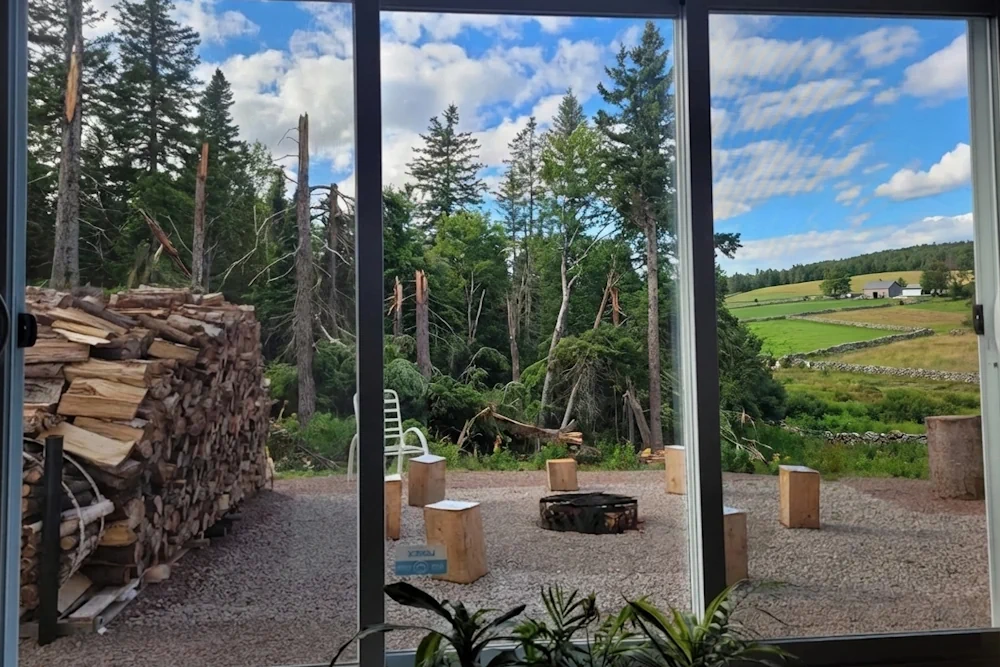
I sat by the back window, gazing into the yard. Suddenly, a striking sight jolted me from my seat. Before me was a scene I had never seen; it was as if a magnificent, vast canvas had been unveiled, revealing a vista of hills and verdant farmlands.
I called Anahita, my wife, and joyfully gestured toward the view. We stared ahead for a few seconds, then turned to each other. Her eyebrows were raised. The storm had shattered or uprooted the shadowy, coarse trees that once blocked our view. A window had opened to a sweeping vista of open land.
We had never imagined such a majestic landscape lay hidden just beyond our yard. Like the view during takeoff, we could trace the farmlands’ boundaries through the multi-directional plow furrows and the shifting hues of autumn stalks. Beyond that seamless patchwork plain, the arched contours of the hills rose like the waves of a beguiling form, resting in quiet anticipation. The furrows in the fields evoked the pleated folds of Iranian girls’ skirts.
Anahita said, “According to Saadi and Rumi, ‘My beloved dwells at home, while I wander the world in vain.’”
I composed for her, “The hero stands in the mirror, yet my heart seeks others to sustain.”
Fiona had brought a touch of beauty and joy to our home.
We were merrymaking when there was a knock at the door. Anahita opened the door. A gracious woman introduced herself as Jessica, and her husband, David, waved from behind the wheel. “We’re your neighbours. We were worried about you since you’re new here. If you need anything, just let us know.”
We did not believe such altruism and kindness existed in the West. After thanking them, we mentioned that we had anticipated some things. They gave us their address, left a thermos of hot coffee and a few bottles of mineral water, then departed.
We were happily drinking the coffee when there was another knock. A man named Barry said he was a carpenter and that if we needed help, he had a saw and a tractor. We thanked him, and before leaving, he also gave us his number and address. After that, a kind man named Grant and his wife Kim called to say they had a generator and tools. It felt as though God had sent earthly angels to aid us in this crisis, granting us peace even while we were far from the city and away from our homeland.
The following mornings, when we opened the door, we’d find a thermos full of coffee along with fruit and cookies left on the front porch. With humility and gratitude, we’d return the containers with a small gift and get charging for the power bank and drinking water from them. When the power outage dragged on, we threw away some of the food from the refrigerator freezer and gave what remained to a neighbour whose refrigerator was running on a generator. Road maintenance labourers, power company employees, city workers, and military personnel were busy clearing and opening roads every day. Finally, after about two weeks, our power was restored. The pleasure of hot water cascading over my skin after days of washing with a damp towel was indescribable.
The storm still rages in Iran. News from that land remains dominated by protests. Before emigrating, I experienced the revolution and war there firsthand and bore witness to numerous crises, yet this time, the methods and slogans are fundamentally different. Most protesters are young people and teenagers who surge into the streets leaderless and in dispersed groups. For those of us who witnessed the silent processions of millions and heard their dignified, ingenious slogans, the thunderous outbursts of today’s youth and their raw insults against the ruling elite are profoundly unsettling. In those days, people would appeal to their familiar, seemingly caring administrators, expressing their aspirations for a better life. But these days, they rebuke their foreign and bloodthirsty plunderers, wishing for their destruction. First, they would chant, “Don’t give oil to Syria while our lamps run dry.” Then they shouted, “The enemy’s right here; they lie that it’s elsewhere.” Gradually, society’s roar became, “Islamic rule, we reject, we defy.” Now, these slogans have metamorphosed into rage-filled roars, with people hurling raw invective at these predators and brigands.
Summer’s fading greens recall the silencing of the Green Movement. Autumn’s colours mirror the vibrant dress of the homeland’s daughters. In the three decades after the ill-fated ’79 revolution, voices of dissent rose, only to be crushed by complacent rulers. Scattered tempests grew louder each year, maturing in 2009. Mir-Hossein, a disillusioned former leader, stepped forward with a promise of political reform and reconciled the withdrawn masses with the ballot box. The spiteful rulers cast him aside through electoral manipulation and elevated a demagogue. The green of Mir-Hossein’s stole became the movement’s symbol, and millions poured into the streets adorned in green. Crowds emerged from every neighbourhood, streaming through the highways in silent defiance. Everyone held just one sign: “Where is my vote?”
The self-proclaimed representatives of God raised their walls and antennas and brought down the satellite dishes from people’s rooftops. On state television, they called themself the Leader of the world’s faithful, named their command the final message of God, and claimed beyond them, there is nothing but darkness. However, the new generation seemingly saw the light and heard a call through the gap between those imposing figures on their smartphones and social networks. The veil of silence receded, and everyone spoke of removing the walls. We did not believe such fearless warriors would rise in the East.
During my call with my niece in Iran, she said, “Uncle, when my children say, ‘We don’t want these old rulers and mindless officials,’ I don’t know what to tell them.”
I said, “My dear, wherever you go, the sky’s the same colour.”
She said, “Uncle, they’ve emptied words of their meaning. A vote no longer means choosing a representative or president—they now call it a ‘pledge of allegiance’ to the leader. They brand the works of thinkers as ‘cultural invasion.’ They label protests as ‘riots’ and uprisings as ‘chaos.’ By this twisted logic, they unleash mercenaries of all kinds and colours on the youth to keep the hollow trunks at the top from collapsing.”
“Look after the children,” I said. “Teenagers act on emotion. They could get themselves in trouble.”
She let out a soft laugh. “Uncle, this generation isn’t like us. Norms have changed. I need my kids to help me adjust my phone and computer settings. If change is coming, it’s through them.”
I shook my head. “Change doesn’t happen without a head, a leader.”
She sighed. “Uncle, amid the daily rush of school life, I noticed things I had never seen before. The days when one person led and the rest followed the flag are over. Today, young people connect through smart devices, shaping virtual leaders together in the clouds.”
I said, “Men’s chests have always been shields defending women. Now, videos show girls dancing on cars or circling around flames and burning headscarves. You don’t even have a daughter—who are you talking about?”
With a shy smile, she said, “Uncle, don’t take offence. You’re from the pre-digital era; we’re from the pre-network age. But today’s youth deal with artificial intelligence. They don’t distinguish between boys and girls; they’re together. To you, they’re like mahrams;[2] to us, they’re like cousins. Of course, it’s true; girls are at the forefront. Remember when there were protests, men would form circles around groups of women? Now, girls don’t just spin their headscarves in the air—they’re swiping turbans off the sheikhs’ heads.”
I laughed. “I know—girls have outpaced boys in plenty of university fields. Honestly, when I saw in the news that girls were telling the officers, ‘Be afraid, be afraid, we are all together,’ I realized that in Iran, too, the era of women’s subordination and silence has ended.”
She said, “How interesting that you changed the slogan. When the black-clad armed officers appear, kids cry out to each other, ‘Don’t be afraid, don’t be afraid—we’re all together!’”
Today, when we woke up, my daughter Mithra was chatting with her friend in Iran on her smart device. Mithra said, “No headscarf in the market? You’re kidding me! This movement is very different from the past. It’s gone beyond whirlwinds and storms as if a hurricane is coming.”
Her friend replied, “Well, yes, this is a game-changer. Mithra dear, they won’t let us move; everywhere we go, there’s a wall in front of us.”
Mithra said, “When peace comes, these walls won’t remain; the country needs rebuilding.”
“Virtual networks have given such power to young people that the dictator is terrified. The big shots keep cranking out new censorship committees and councils. They’re trying to bring down a sky full of soaring birds with mere stones.”
“Our cultural and historical roots are top-notch; we need skilled planners and directors. The foreigners won’t lift a finger to help; we must recognize our own heroes. Iran’s past is full of great political and literary heroes, from Kaveh and Rostam to Saadi and Sohrab.”
Her friend chuckled. “Talk about the great women in our history—Mandana and Atossa to Parvin and Forough. Darling, today’s Iran isn’t what it was when you left. Kids aren’t looking to Western or Arabic role models anymore. With modern technology, they’re reviving long-forgotten myths.”
“Yes, I see the Farsi online talks and training.”
“It’s far beyond that, dear. I can’t talk about organizing and leadership tactics here. In any case, experiencing reality up close gives a whole different feeling.”
Mithra said, ‘I know that facing darkness every day is painful for you, but we who have fallen away from the homeland suffer two other kinds of pain: first from separation, and second from seeing things that, when we were inside, noise and habit did not allow us to see.
With the help of our neighbours, we’re clearing the aftermath of the storm’s destruction. I never imagined uprooting those old, cumbersome trunks would be this easy—they’re all hollow and rootless.
The backyard is now so sunlit that the light and view make it perfect for a Persian-style courtyard. Mythra pulls the blueprint from the chest, and she and Anahita set to work marking the ground. Before implementing the design, we’ll consult with the neighbours. They’re always open to new ideas.
[1] Mihr: The first month of autumn in the Iranian calendar, that begins in September and ends in October.
[2] Mahram: Immediate family members who can freely interact but are prohibited from marriage under Islamic law.