
You Know How Expensive It’s Gotten?
When my wife hung up, she burst into tears. “So when, then?”
I set my pen on the blueprint and stood up from my desk. I sat beside her and hugged her. “My dear, you were laughing on the phone, so what happened?”
She lifted her head and said with a coquet smile, “It was Mom. She was calling from my nephew’s circumcision ceremony.” She wiped her tears. “Mom brought up my childbearing again, saying, ‘Now that you’ve gone to your dreamland get moving. Have children while you’re still young.’ My late grandma always used to say, ‘Having a child in old age is like tying a bell to a coffin.’”
I smiled. “Oh, come on! We’ve got ages till old age. Why are you getting anxious now, just because your doctor’s appointment is coming up? Let’s take this short trip, come back, and then we’ll hit the target.”
We both laughed. I went on, “You’re always working out and dancing to stay in shape. Don’t come back later saying, ‘I got carried away with pleasures and wanted a child.’ Let me warn you now—pregnancy and breastfeeding might change your body.”
She shot me a sideways glance. “Mayar, stop repeating yourself. I don’t care about my figure or empty pleasures. I just want a baby. Got that? I’m dying to hear my baby’s Vang Vang, to soothe them with my milk-heavy breasts.”
I smirked. “That’s simple, sweetheart. I can vang vang for you. Will you soothe me then?”
She scoffed and shook her head. Her gaze climbed the wall to her grandma’s keepsake doll. “You don’t get it. You’ll never understand what it means to be a mother. Back in Iran, we said, ‘The economy and schools here aren’t great, let’s go to Canada and start a family.’ I’m thirty-five now, and you’re almost forty-five. I’m worried about the risks of pregnancy after thirty-five—”
I interrupted her. “Alright, love, I know all this already. I’m not against it… Come on, let’s go pick out a gift for Ashkan and Shirin. It’ll cheer you up.”
Ashkan, my old hometown friend and schoolmate, had invited us to their home for the weekend. Mehri was distantly related to his family. We were excited to go. We had been craving an Iranian gathering, and after years, we were seeing their family again.
I came across Ashkan on social media a few months back. We messaged each other and checked in on how we were doing. He had posted plenty of cheerful photos with his sister, brothers, and mother, but there was no sign of his father. When I asked, “How’s your father, Doctor?” he changed the subject. Then, last week, he wrote, “We’re having a small get-together on Saturday. Mom said, ‘Tell Mayar and Mehri to come too.’”
My acquaintance with Mehri took shape in a cultural hangout. It was a centre Ashkan’s father, a well-known surgeon in our city, had set up for young people. Mehri and I worked together on a research project, and in that first shared social experience, we fell for each other. A while later, when the government shut down non-governmental organizations, that centre was gone as well. Around then, Ashkan’s family emigrated to Canada. As for us, life unfolded in a way that led us to Canada just last year. We were curious to see, up close, how the doctor had settled into his new country.
Saturday morning, we set off in our small car for Ashkan’s gathering. On the way, we talked about the doctor.
I said, “Remember how stunned we were when we heard he’d sold his practice? Later, we realized how timely that move was. He read the signs early and took his family out.”
Mehri said, “Yeah, but selling the practice had nothing to do with what was going on outside. After his heart attack, he told my father, who’d gone to see him, ‘My heart woke me up at the best point in my life. I got the message, and I stopped running.’ He walked away from medical practice. He stayed on as a university professor, though, and worked with a few charities.”
I said, “I’d heard him say he was firmly against leaving. So what changed?”
She said, “They shut down the centre. And at the university, they were pushing out one ‘outsider’ professor after another…”
The last time we saw the doctor was at our engagement party. That night, Ashkan pulled me aside and said, “My father has sold the house and many of his belongings. He’s taking us to Canada.”
I asked, “But you haven’t done your military service. How are you even leaving the country?”
He answered, “My father went through a lot of trouble and expense to get us one-time exit permits.”
We drove for three hours before reaching Toronto. In the affluent neighbourhood of Richmond Hill, we had no trouble finding Ashkan’s house. Just as he’d said, his orange Volvo SUV was parked out front. Ashkan and his fiancée, Hanna, came out to greet us and led Mehri and me through the hall, past the side yard, and onto a wide porch at the back of the house. Hanna looked younger than I’d expected, maybe in her early twenties. She wore stylish square glasses, and her dark hair was tied up in a loose, messy bun. She spoke English with an easy Canadian accent and now and then slipped in a line of Farsi. She moved with the calm confidence I’d seen in many women raised in Canada.
Mehri looked both excited and tense. As her eyes drifted over the luxurious furniture, I sensed a mix of admiration and something unspoken. Perhaps she was measuring it against the simple things in our rented basement apartment in Kingston. When she complimented the flowers, her smile opened a little too wide.
Seeing the atmosphere of that magnificent house and the garden full of flowers and plants, Mehri and I smiled at each other with raised eyebrows. Under a gazebo next to a barbecue setup, they had arranged sofas and chairs, along with fruit and sweets.
I said to Ashkan, “Mashallah,[1] your yard is beautiful. Though I know you have harsh winters.”
He asked, “Harsh? Why?”
Mehri laughed. “The first winter here wasn’t a good experience for Mayar.”
I glanced at Mehri with a sheepish smile. “Don’t embarrass me, sweetheart.”
Then, with a quick laugh, I turned to Ashkan. “So how do you deal with all this snow around the house and the sidewalks in winter? A few months ago, I had a pretty rough fall and ended up stuck at home for a week. Remember that heavy snowfall? Our landlord had gone to a party the night before and couldn’t get back. There was almost a metre of snow piled up in front of the house. I saw the shovel, grabbed it, and went out to clear a path. I slipped so badly it’s hard to describe. I was lucky I didn’t hit my head.”
Ashkan roared with laughter. “Man, this is Canada, nobody shovels by hand. A house needs a snowblower.”
“Snowblower? Those big noisy clunky things on wheels?”
He said, “They come in various sizes, from small electric ones to larger ones with gasoline engines. Like that one, look.” He pointed to a large wooden shed at the side of the yard, with its two doors open. “See that big machine at the back of the shed with the black cover? That’s a snowblower. Of course, since I bought it, it’s just been brand new on that corner. In winter, I have a contract with my neighbour’s worker to clear the snow.”
We were mid-conversation when a red Tesla rolled into the yard. Shirin, Ashkan’s sister, stepped out from behind the wheel, their mother following from the back seat. I remembered Shirin as a quiet, dark-haired teenager. Now I saw a blonde woman with a supple grace, dressed in a red leather skirt suit, her jewellery catching the light. She changed her shoes by the driver’s door, swung a large black bag over her shoulder, and walked toward us, her metal heels tapping as she came. A cool spring breeze moved through the yard, carrying her perfume with it.
Their mother wore a mustard wide-brimmed hat and a loose, chocolate-coloured outfit with a broad collar.
A little girl, not yet four, jumped out from the far side and darted toward the street. Shirin turned. Their mother ran after her, caught her hand just in time, and pulled her back into the yard as the child screamed.
Shirin slipped a few strands of blonde hair behind her ear and said, “My daughter, Alina dear, calm down so I can greet our guests.” Then, still watching Alina, she wrapped Mehri in a warm embrace.
As the child kept bouncing up and down, Shirin’s mother chatted with us, warm and at ease. While we talked, Alina stared at the ground, snapping her head from side to side.
Ashkan’s mother crouched in front of her and pointed toward the far end of the yard. “Sweetheart, let’s go behind the garden beds and see the chickens and roosters in their cage.”
Alina shot us a sour look and went off with her grandmother.
Shirin followed them with her eyes, her shoulders drooping until they were out of sight. Then she straightened. She took two large containers from her car and set them beside the barbecue. “Ashkan dear, I’ve marinated the chicken and chenjeh. They’re ready to skewer.” Then she sat beside Mehri and steered the conversation toward things far from her worries.
While they were chatting, I drifted toward the sliding glass doors and looked inside. The interior was as striking as the yard: high ceilings, modern furniture, a formal dining room with polished surfaces.
What caught my eye was a wall of family photographs. The children appeared with their mother at different moments—graduations, trips, and family outings. Yet something felt off. In several frames, the spacing was strange, as if someone had been carefully lifted from the edge of a photo or quietly removed from the middle of a group.
A sleek pickup truck rolled into the yard. A tall man in his mid-thirties stepped out, with a neatly trimmed beard, jeans, and a brown plaid jacket. He walked with the kind of confidence that made it seem as if the place already belonged to him.
Ashkan got up to welcome him and said, “This is Mr. Saeed, Tehran-born, one of Toronto’s new developers. His father’s company handles the prep work on some of the city’s prime plots.”
Saeed smiled warmly, took my hand in both of his, and said in lightly accented Farsi, “It’s always good to meet fellow Iranians, especially engineers. We could use more solid people like you in construction here.”
Hannah handed something tube-like to Ashkan and said, “Kebab skewers.”
As Ashkan got busy with the kebabs, I stepped in to help. We talked about school and work. He said, “Hanna studied literature. After coming to Canada, I did business at Ivey, down in London, here in Ontario.
I said, “Yes, I know it, you mean Western University. It’s too expensive, man!”
Ashkan nodded. “Yes, the tuition is high. Anyway, if you want peace of mind for the future, you have to spend money.” He laughed. “Mayar, have you heard the saying, ‘Whoever gives teeth, gives bread’? The father who brought us here should pay for us, right?” He offered Saeed some fruit and continued, “At first, I had a government job, but you know? In those jobs, they don’t let people like us rise too high because we’re not ‘insiders.’ I took some capital from my father and started my own business.”
Hannah approached. She held Ashkan’s smartphone towards him and said, “Your phone rang. Since it was someone familiar, I answered. Your brother Arman wants to discuss something urgent with you.”
Ashkan wiped his hands on the small towel tucked into his belt. He took the phone and walked away, his shoulders tensing as he listened.
I thought of Arman. Back when Ashkan and I were still in high school, his brother Arman had already gone off to university. I kept myself busy with the kebabs, lining up the meat so each skewer would carry the same share. The pieces had been cut so evenly, with such a sharp knife, that it spoke of real skill, or at least a careful eye. When I snapped out of it, I realized I was doing the math. How many weeks of our grocery shopping would the cost of this meat cover?
After the phone conversation with his brother, Ashkan whispered something to Hannah and told us, “I apologize deeply. I need to go pick up Arman. I’ll be back soon. Bro got stuck without a car out of nowhere.” He told Hannah, “Put on some music so they don’t get bored.”
When Ashkan left, Hannah headed toward the building. Her silver bracelets jangled as she adjusted settings on her phone. The gentle sound of a guitar played from two speakers on the gazebo ceiling.
A little while later Hannah returned with a tray and placed it on the table, her movements quick and efficient. The aroma of Iranian tea filled the air. The carnelian-coloured red tea gleamed in the slim waist glasses.
Mehri seemed to have relaxed, conversing easily with Shirin about mutual acquaintances from their hometown. I caught fragments about someone’s wedding, someone else’s new job. Mehri’s hands, usually fidgeting in unfamiliar social situations, were still and calm as she accepted a glass of tea from Hannah. She belonged here in a way that surprised me—as if these people, despite their wealth, were somehow more familiar to her than our Canadian neighbors in Kingston.
Alina and her grandmother were returning, and Saeed was telling me about the real estate boom in Toronto. I had music in my ears when I saw Alina throw an angry look at the gazebo ceiling and cover her ears with her palms. Then, she began rocking herself back and forth.
Shirin, quickly moving toward Alina, said, “Hannah!” and, with stiffened shoulders, pointed to the speaker. “The music!”
Hannah jumped up so suddenly that she almost spilled her tea. “Oh, you’re right, sorry.” Her hand moved uncertainly over her smart device, and she frantically tapped it a few times with her long fingers until the music stopped. She pushed her glasses up on her nose, looking genuinely contrite. “I’m sorry, I totally forgot the sound bothers her.”
As Shirin knelt beside Alina, her mother leaned over to advise her. “Perhaps if you would more—”
Shirin cut off her words abruptly. “Got it.”
Shirin’s phone buzzed on the table. She glanced at it, hit the red button, and firmly set it aside.
Hannah quietly asked, “Is everything okay?”
Shirin adjusted Alina’s collar and said, “Next week is the court appointment. I’ll finally be free of her father.”
“Dear Shirin, what does your father, the doctor, think about this?”
Mehri asked. Oblivious to the sudden tension her question created.
The conversation halted. Hannah’s eyes widened slightly, and their mother became suddenly interested in the teacups.
Mehri looked at me from across the table. Confusion rippled through her furrowed brows. As if she had just realized she had asked something bad. I moved my head and told her to change the subject.
A little later, Shirin said, “My father doesn’t know about Alina.”
Hannah said to me and Saeed, “Please help yourselves.” Then, with a chuckle to Mehri, she continued, “Let me tell you about Ashkan and why he left now. Their older brother, Aryan, has a fourteen-year-old son who climbs straight up walls. Today, he took his uncle Arman’s Lexus from the garage and hit the neighbour’s little girl. The girl’s parents’ travel plans were disrupted. Their daughter is hospitalized in intensive care. The police impounded the car and told Arman to go until the court date. Ashkan went to pick up Arman from the police station.”
Mehri said, “Yes, my mom says, ‘Only children are more restless, it’s better to have at least two children in a row.’”
Hannah slapped the back of her own hand. “Oh no! Aryan has three children. I say even one is too many. I recently read a story where the protagonist said something interesting. ‘Marriage is for the pleasure of living and jumping, not for the ecstasy of sleeping and giving birth.’ Honestly, when I see some girls having children just for the desire of monthly child benefits, I don’t like it at all. I never want to become a baby factory; let them call it selfish. My own sister’s life was sacrificed for her child.”
Mehri asked, “How?”
Hannah lowered her head and exhaled forcefully. “Let’s move on; plenty of examples are around us.”
Shirin said, “I agree with Hannah. One must keep their eyes open when they’re at their peak.”
Suddenly, a child’s scream echoed through the yard, and Alina ran toward the barbecue. The extinguished grill tilted over the table beside it with her impact. The water pitcher fell and splashed everywhere.
Shirin leaped and caught the table before it fell on her daughter. “Watch out, my daughter!”
Their mother picked up a cloth and dried everywhere. “If you had told your father, that loafer wouldn’t have dared to abandon the child and leave.”
Shirin hugged Alina tightly and turned to her mother. “Maman, come sit. You’re exhausted. She didn’t let you sleep last night either.”
Alina wriggled in Shirin’s arms and shouted until she jumped out and threw herself face down on the ground. Her grandmother picked her up and carried her toward the house. “Come on, Alina dear, let’s learn how to cook pilaf.” Shirin picked up her glass and followed them into the kitchen.
Mehri asked, “Doesn’t the child’s father help?”
Hannah gave a bitter smile. “Nothing. He said, ‘I wanted marriage for peace, not to raise an animal.’” Her face reddened. “Sorry, that’s what Shirin said. When Alina’s father found out what was wrong with the child, he snapped at Shirin, ‘Either put her in an institution or raise her by yourself.’”
Mehri whispered, “That’s terrible! I wish the doctor knew.”
Hannah adjusted her glasses. “Shirin got married without her father knowing. Since they came to Canada, everyone has gone their own way. The doctor built a big house so everyone could live together, but it seems only he wanted this.”
Mehri stared at her with creased brows and said nothing.
Hannah continued, “I heard from Ashkan that while the house was being built, their father would go to Iran and come back, leaving the project to his eldest son. His children and wife each gave orders that kept increasing the expenses. The doctor told Aryan, ‘Without permission, you took tens of thousands of dollars in cash and building materials, started your own company, and built a separate house for yourself.’” She paused and continued, “In short, his financial situation was ruined, and he had no assets or income.”
“What happened to the house?” I asked, thinking of the photo wall with its conspicuous gaps.
Hannah replied, “Sold, half price. After the Doctor left, their mother couldn’t keep the house.”
Saeed pulled his chair a little closer. “Construction costs can skyrocket if you’re not careful, right, Engineer?” He glanced at me, and I nodded. “My father saw the whole thing unravel. Said by the time the final accounting was done, the Doctor was in shock. It was a strange scene. At first, he was restless, shouting. Then he just… went silent.” He took a sip of his tea. “Later, we all heard he left that house with nothing but a suitcase.”
“Where did he go?” I asked.
Saeed said, “An old cottage deep in the countryside. No idea how he managed out there. Those places, especially in winter, are where Canadians live when their kids are grown. At his age, it couldn’t have been easy. But you know what?” He glanced toward the street. “City life is expensive. He just couldn’t afford it.”
I let my gaze drift over Ashkan’s house and yard. “The Doctor was a wealthy and generous man.”
Mehri said, “His kids adored him.”
Hannah added, “Ashkan resents his father. Says, ‘Sometimes when I sent him a couple thousand dollars, he sent it back. His expectations are too high.’ The Doctor told him, ‘I always saw you kids as my partners.’”
Saeed held his tea glass up to the light. “Last year, when the Doctor came by my company, he was driving an old Chevy, asking where to find cheap tires.” He lowered his head and murmured, “Ashkan was upset with me once. He was complaining about his father leaving their mother. I told him, ‘Look, we saw your father build that house to stay. What happened that made him leave? And look at yourselves. You’ve all changed partners more times than I can count. Why judge him?’
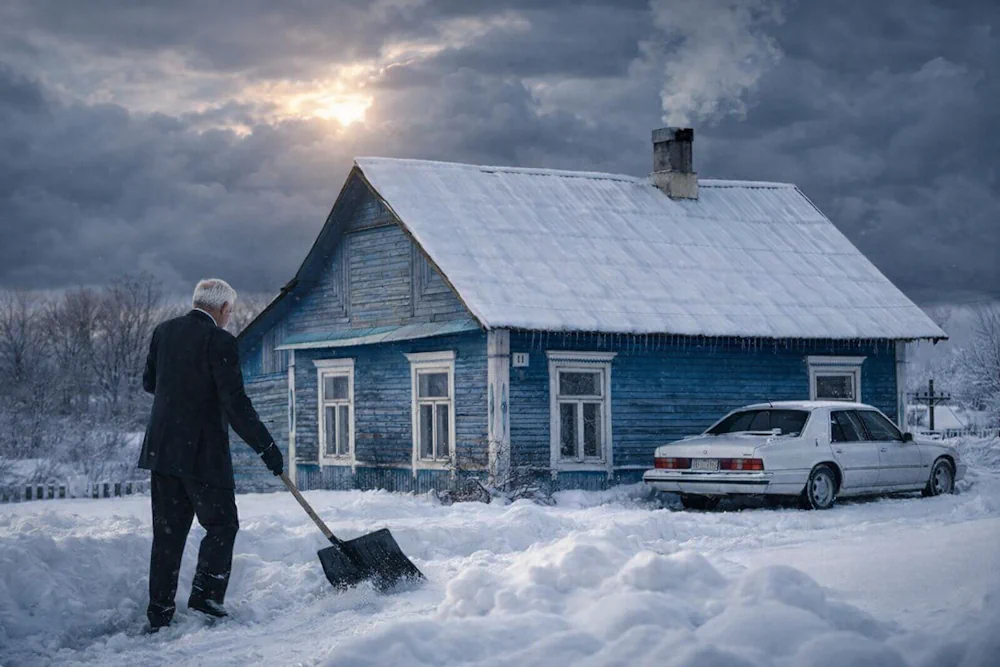
“I heard that this past February, the Doctor was out shovelling snow when his back locked up. He collapsed in his driveway. It was hours before anyone found him.”
The orange Volvo parked in the yard. Ashkan and a man with a ponytail and cigarette on his lips got out. The man introduced himself as Arman. Flustered, I apologized, “I’m sorry, Mr. Arman, I didn’t recognize you.”
Arman laughed heartily. “Engineer Mayar, did you think I’d stay the same as when you saw me in Iran? Fellow townsman, we’ve aged beyond recognition. Life’s troubles leave no joy for a person. But mashallah you’ve aged well.”
I said, “You are good, the fault is in my memory. How is the doctor? How is brother Aryan?”
He said, “Honestly, last year I didn’t have a single white hair. This year, I’ve got over a hundred. Aryan’s hair’s mostly white now.”
I said, “If you’re good with your life, that’s what counts. Hair doesn’t mean a thing, right?”
Arman replied, “You sound just like the fathers. What contentment, bro? In capitalist countries, if you’re not careful, you’ll end up in the gutter. With a low income, I had a comfortable living, I fell for the bank’s trick, ended up in a hole. I mean, the bank’s consultant informed me that my low-interest loan was approved. After COVID, the housing market was hot. I was a fool, I took on a heavy loan. The city just slapped a permit for a high-rise on us. We started with a few partners. Now that we’ve reached the upper floors, our bad luck has driven the costs to the sky, workers and materials are rare. I’m telling you this because I know you’re involved. Ashkan says you’re an engineer and wealthy man.”
The fact that Ashkan thought of me as “wealthy” made my heart sink. All my savings from Iran, in dollars, didn’t even reach fifty thousand, now that less than thirty remains.
Arman asked, “Engineer, why did you go so far, to a small place? A whale can’t live in a pond or pool, so come to the big city; it’s an ocean of opportunities.”
I said, “Mehri’s university and my work visa keep us there until we get Canadian residency.”
He nodded. “Ah, so PR’s got you locked in.” Then, laughing, he added, “The day we arrived, my father didn’t let us sleep. He dragged us out and shoved the permanent residency card into our wallet.”
From the barbecue, Ashkan called out, “Arman, you’re preaching again? Come help instead of giving our guests a headache.”
Arman replied, “I’m coming, lazybones.” While walking, he struck a match and lit another cigarette.
The smell of sulphur and cigarette smoke overpowered the scent of flowers. “Is the Doctor coming tonight?” I asked, my curiosity getting the better of my discretion.
Arman stopped mid-step, as if he’d frozen. The cigarette hung from his lips.
“Honestly, I don’t know. Ask Ashkan. He’s the one still in touch.”
He took a few steps back.
“Our father treated us like strangers. When he brought us to Canada, he put a small amount in front of us, a hundred thousand each, and said, ‘I got you through your bachelor’s. This is your capital. Go make your own way.’ Believe it or not, he made Aryan and me leave the house. He said we could come back once the place was built. We didn’t. We figured things out on our own.”
I said, “Arman, family credit means a lot in roving. I had to beg someone to cosign just to get a fifteen-thousand-dollar car loan. It’s going to take a long time to build my credit.”
As Arman walked toward Ashkan, he called out, “Ashkan, Engineer Mayar is asking about Dad. Is he coming?”
Ashkan said, “I haven’t seen him for a while. His phone isn’t answering.”
Arman turned to Shirin and said, “Tell Mom not to forget to sprinkle barberries and saffron on the pilaf; Mayar and Mrs. Mehri still have a strong sense of Iranian tastes.”
I followed Arman to the barbecue. Ashkan was laying skewers over the glowing coals. Fat dripped from the meat, sizzling as it hit the fire. Smoke and the aroma of kebabs filled the air. I grabbed tongs and helped turn them. The heat scorched my face.
Ashkan looked up from the grill, wiping his brow with his forearm. “Today I remembered something I wanted to ask you, Arman. What did you do about the snowblower at last?”
Arman flicked ash from his cigarette onto the pristine patio stones. “What did you think? I’m not waiting for you. You put your machine aside and didn’t send it to me. At the end of winter, I found one half-price at a sale and bought it. Though it cost me more than your device’s fee.”
Their mother’s voice called from inside, “Someone come help me, this gas stove has gone out, maybe the tank is empty.”
Ashkan raised his voice, still focused on the grill. “I’m coming, mother. You need to check the safety valve underneath. When the gas flow surges, it shuts off automatically.”
I set the tongs back in place, a good chance to escape the heat and smoke. I got up. “I know how, I’ll take care of it.”
I headed to the kitchen, the brothers’ conversation continuing behind me. As I passed through the glass door, the cool breeze from the air conditioning met my hot skin, and my face bloomed. I sucked the air all the way down to the pit of my stomach.
Mehri was already there, helping Ashkan’s mother unload the dishwasher and set the dishes on the counter. Their mother’s gold bangles rang against the china. My attention caught on a piece of paper pinned to the fridge under a magnet—crayon scribbles, with “Alina” written below in an adult’s handwriting. Above it, a small calendar hung, a red circle marking a day. Next week’s court date came to mind.
I opened the vent under the stove and checked the gas control valve. Through the open kitchen door, I saw Ashkan and Arman, heads bent toward each other as they walked toward the back entrance, talking. They paused just outside, unaware of me kneeling by the stove.
“Look, Arman, I’d told you, I’ve been promising Father for three years that I’d bring him the snowblower, but I keep forgetting.”
Arman said, “He can handle himself. Just worry about your own affairs. No need to send a snowblower to anyone. You know how expensive it’s gotten? Like everything else.”
“Really?”
“Of course! Sell it, let it go. That’s no small sum, enough for a New York tour. Go enjoy yourself.”
Ashkan looked at him and a moment later said, “That’s right, Okay.”
A red light was blinking on the gas control valve. I pressed the button beside it. When I heard the hiss of gas, I straightened up. I was thinking about what Ashkan and Arman had said. My eyes fell on Mehri. Her cheeks were flushed, and she was looking at the two brothers. She turned to me. I shook my head. She bit her lower lip.
Their mother noticed Mehri and said, “My flower daughter, don’t be surprised by Arman’s words. Wherever you go, the sky stays the same. Whether in Iran or Canada, prices are going up everywhere.”
That night, laughter and conversation filled the house. Ashkan’s family went out of their way to host us and insisted we stay the night. But Mehri had studying to do, so we declined.
On the way back, we sat in silence, watching the dark pass by outside. Now and then, the glow of streetlights flickered across Mehri’s face. She held herself, occasionally twisting her wedding ring with her right hand, a habit I had noticed during serious conversations.
The highways ended, and we left Toronto behind. Still, neither of us spoke. Scattered thoughts unsettled my mind. Alina’s autism. The neighbour’s child’s accident. Passing the doctor. The abandoned snowblower. Shovelling by hand. Mehri’s nephew’s circumcision. At the memory of some childhood moments, I smiled without meaning to. At the thought of my parents’ faces, my eyes filled. I looked at Mehri. She was turned inward.
The only sound between us was the steady rhythm of the wipers cutting through the light rain on the windshield. Suddenly, Mehri drew a deep breath. It seemed she wanted to speak, but she didn’t.
At last, as we passed the Kingston city sign, she broke the silence. “Mayar, cancel the IVF appointment on Monday.”
My breath caught. We had gone through a lot to get that appointment. Months of referrals from one doctor to another, waiting lists, all kinds of tests. I looked at her, trying to see her face clearly in the dim light.
She met my eyes. She had already decided. “I don’t want a child anymore.”
I asked, “What about adoption?”
She shook her head. “We’ll think about it.” Her voice was soft, but sure. “Not now.”
[1] Mashallah: a casual expression used when admiring something, a mix of praise and a way of avoiding bad luck or envy.